AVM B1 #
The AVM B1 is an active ISDN controller and was built for the ISA bus up to version 2.0.
Update 2026-08-31: Apparently, v3.0 was also available as ISA card - I never had one of these. Thanks to Götz of knubbelmac.de for the hint!
Up to version 3.0 it uses a T400 transputer.
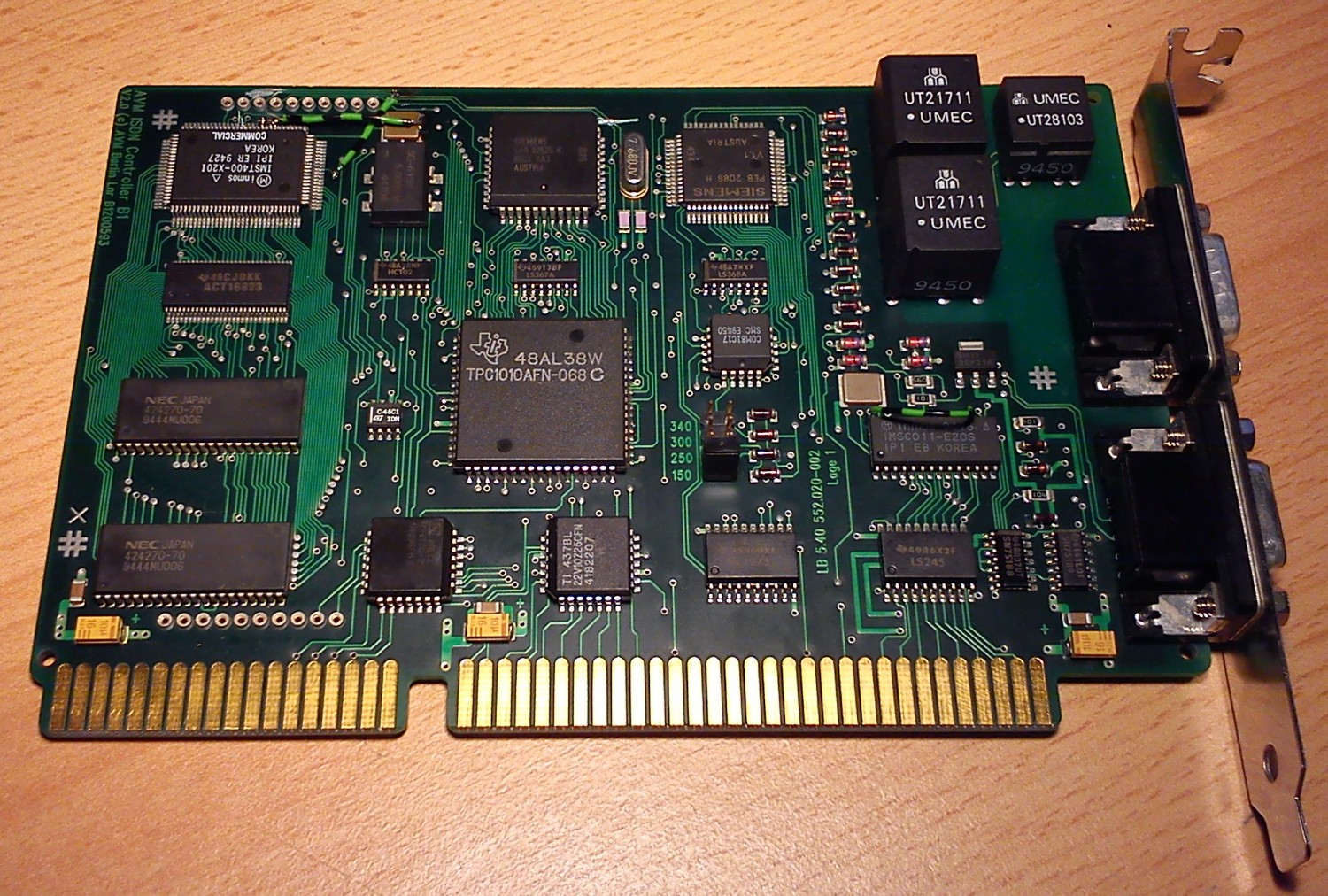
On the left side of the card sits a small transputer system with 1 MB of RAM and a TRAM-like expansion interface. At the bottom right is the C011, which can be addressed from the ISA bus on one of four jumper-selectable addresses. On the B1 the C011 is hard-wired to link 0 of the T400. AVM has wired the links on the board for 10 Mbit/s.
I have made a few modifications to this B1:
First, the link speed of the C011 was raised to 20 Mbit/s:
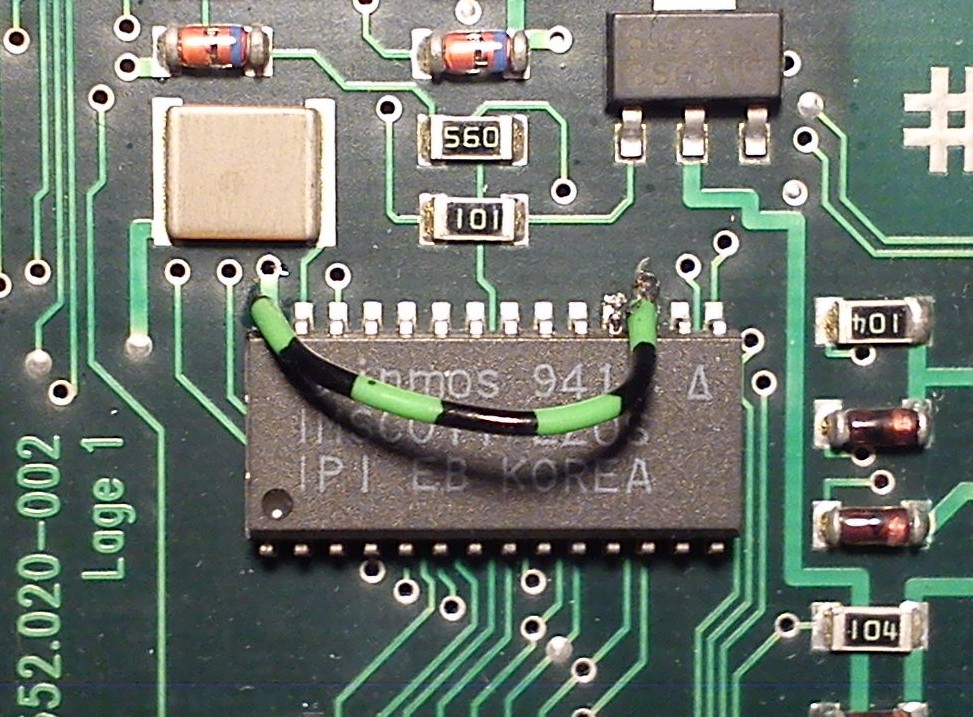
For this, pin 17 is bent up using a fine tool – I used a sharp probe tip – and wired to +5V, e.g. pin 28 of the C011. Now of course the link speed of the T400 has to be adjusted as well:
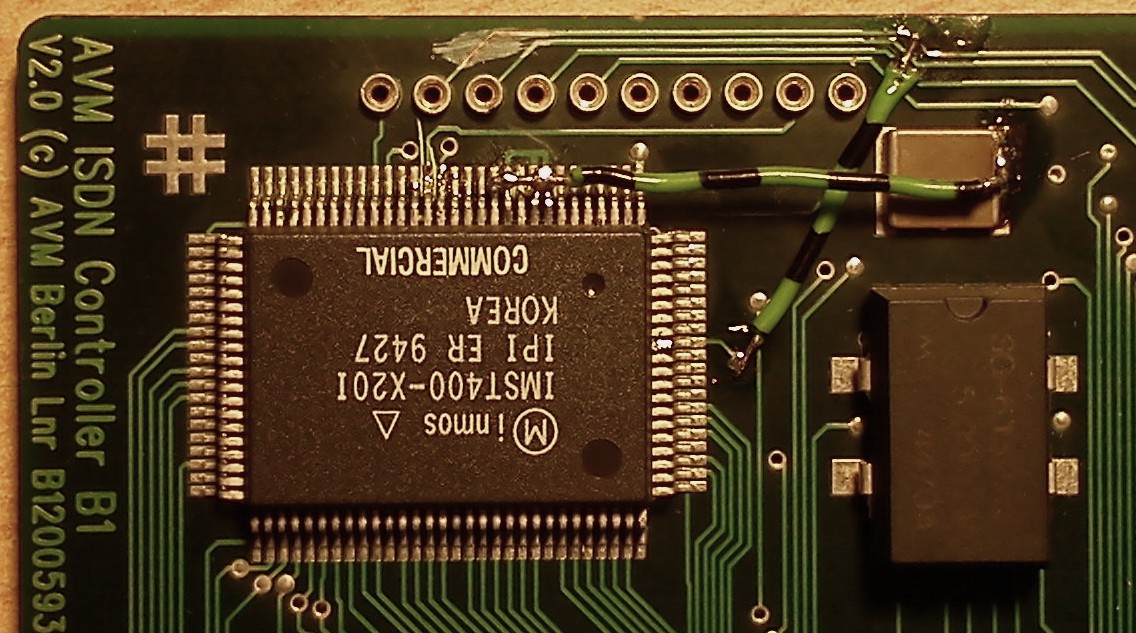
This is unfortunately a bit fiddlier, as the T400 has an even tighter pin pitch than the C011. Pins 8, 9 and 11 have to be bent up and tied to +5V, e.g. on the 1 uF capacitor that is soldered right next to the T400 and serves to buffer the internal supply voltage of the T400’s link interface.
It is also handy, as will become apparent later, to have the RESET pin present on the expansion bus. Pin 2 is not used by the B1’s normal operation and can therefore be cut at the marked location and wired with a piece of wire to pin 92 of the T400, or to a nearby via.
The pinout of the expansion bus, as far as I have measured it, is then as follows:
| Pin | Meaning | Pin | Meaning |
|---|---|---|---|
| 1 | ? | 11 | ? (PAL) |
| 2 | RESET | 12 | ? (PAL) |
| 3 | ? (82525) | 13 | GND |
| 4 | ? (82525) | 14 | GND |
| 5 | ? (82525) | 15 | GND |
| 6 | ? | 16 | GND |
| 7 | ? | 17 | GND |
| 8 | Link1Out | 18 | +5V |
| 9 | Link1In | 19 | +5V |
| 10 | ? | 20 | +5V |
At the latest at this point you should use ispy to check whether the card still works correctly, and if not, start troubleshooting.
You may now wonder what these modifications are for. Since the B1 is addressable at 0x150 and behaves there like an Inmos B004 transputer development board, it makes for a very cheap and direct transputer entry-level card. If link 1, which is brought out to the expansion bus (see above), now leads “outside”, you can hook up further transputer(s) (or transputer networks) – for example the AVM T1 (-B if you have one).
For that you need an RS-422 converter, which is plugged onto the B1:
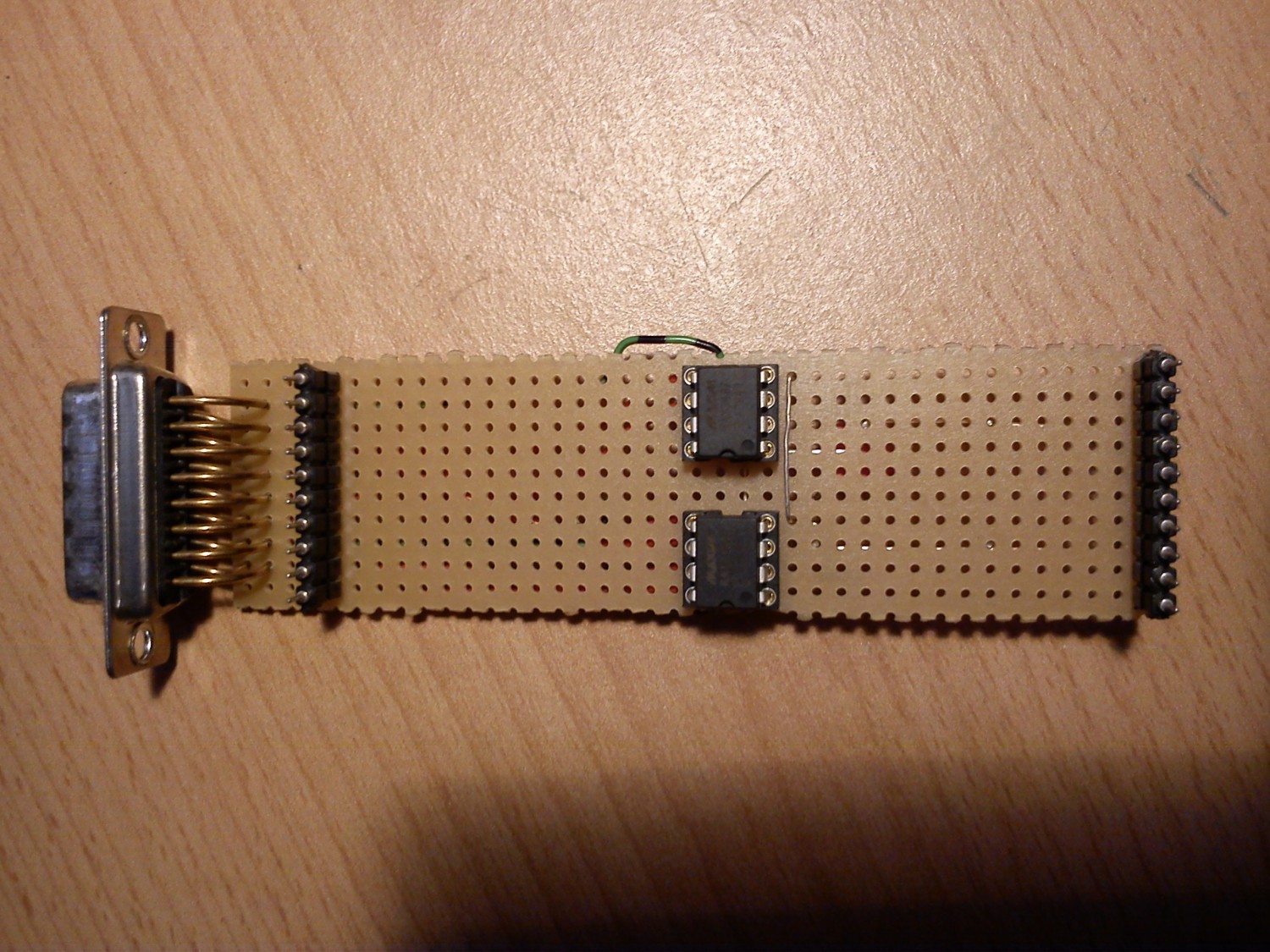
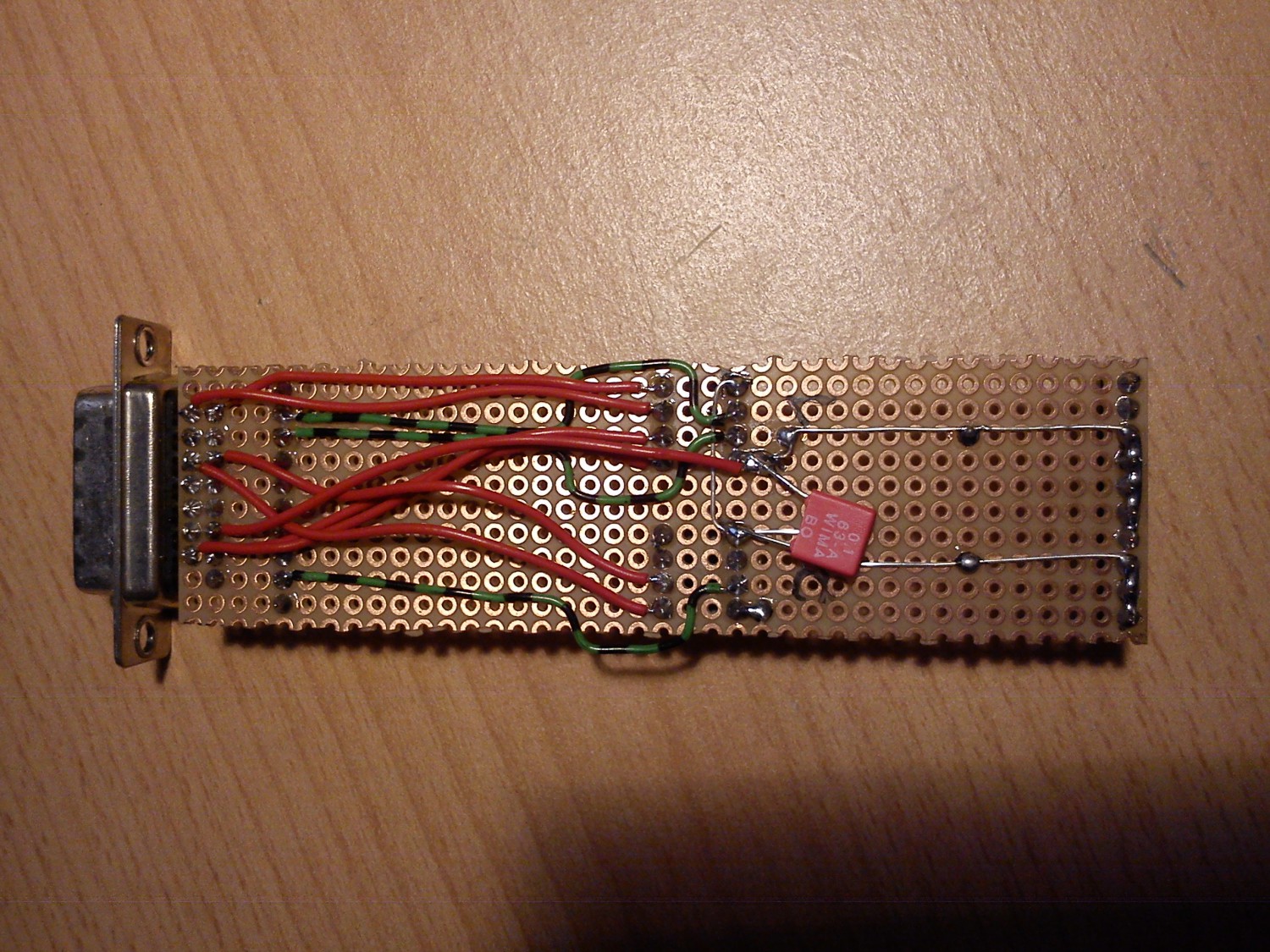
Maxim gives you two MAX3467 chips for free as samples. They are RS-422 converters good for up to 40 Mbit/s – more than enough for the transputer links. They are wired up according to the schematic below, ideally on a piece of perfboard. The 15-pin D-Sub connector is not strictly necessary, but since I use the original cable for the connection to the T1 I have used one here. The pinout of that cable, along with further information about the T1, can be found on the corresponding page.